
Deeply grasp the Dangers faced by major Communist parties
April 2023
Author He Husheng, is from Marxism School of Renmin University, Beijing
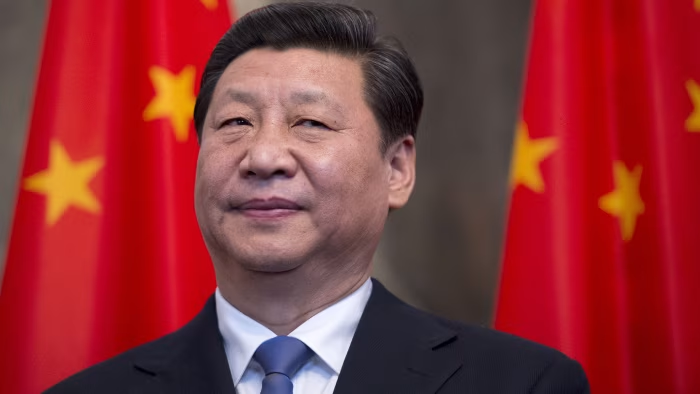
As the world’s largest Marxist ruling party, the Communist Party of China must maintain a clear-headed and resolute approach to resolving the unique challenges faced by large parties in order to consistently win the support of the people and consolidate its long-term ruling position. At the Second Plenary Session of the 20th Central Commission for Discipline Inspection, Xi Jinping profoundly elucidated these unique challenges with “six ‘hows to always’,” fully demonstrating our Party’s deep understanding of its own nature, current situation, tasks, and evolving circumstances, showcasing a strong sense of crisis, clear political awareness, and firm strategic confidence. We must deeply grasp the inherent meaning of these unique challenges from both historical and contemporary perspectives, thoroughly understand their distinctive characteristics of being “unique” and “difficult,” and strengthen the Party through self-revolution, delivering a new and outstanding answer to history and the people on this new journey of self-examination.
Understanding the unique challenges faced by major parties by examining their nature and characteristics reveals where their uniqueness lies.
General Secretary Xi Jinping pointed out: “It is not easy to manage such a large party well, and it is even more difficult to build such a large party into a strong Marxist ruling party.” A large party and a large country are both advantages for us in accomplishing great things and building a great nation, but they also present us with many unique challenges in governing the party and the country. To understand the unique challenges faced by our party as a large party, we need to accurately grasp them from three dimensions: party attributes, value orientation, and organizational scale.
From the perspective of political party affiliation, Marxist political parties are characterized by their progressiveness, inherently possessing an unyielding pursuit of advancement and purity, and shouldering the mission of making new and greater contributions to humanity.
How to consistently and promptly identify and resolve its own problems is one of the unique challenges facing the Communist Party of China as a Marxist party. The advanced nature of a Marxist party is not innate, but rather forged through continuous self-revolution.
,General Secretary Xi Jinping warned the entire Party: “Such a large party, in its ruling position and controlling ruling resources, is easily susceptible to neglecting its own shortcomings and problems under the halo of its achievements, falling into the predicament of ‘it’s easy to reform others, but difficult to reform ourselves.’”
Since the 18th National Congress of the Communist Party of China, our Party has steadfastly promoted comprehensive and strict Party governance, resolving many prominent issues within the Party. However, Party building, especially the building of Party conduct and integrity and the fight against corruption, faces many stubborn and recurring problems. If these are not strictly prevented and promptly rectified, they will inevitably rebound and lead to the loss of all previous gains.
Maintaining a spirit of dedication and entrepreneurship is one of the unique challenges facing the Communist Party of China (CPC) as a Marxist party. Marxist parties possess lofty social ideals and a great historical mission, holding firm to their ideals and beliefs and striving tirelessly for them. History tells us that Marxist parties are the most capable political leaders in achieving social change. However, Marxist parties that have achieved some victories are also prone to becoming complacent, satisfied with the status quo, and losing their revolutionary spirit and fighting will—the lessons of the Soviet Union and the Communist Parties of Eastern Europe are still fresh in our minds. General Secretary Xi Jinping admonished the entire Party: “We are revolutionaries; we must not lose our revolutionary spirit.” Communists are always revolutionaries and should always maintain a spirit of dedication and entrepreneurship, using a vigorous revolutionary spirit to promote self-revolution and lead social revolution. How to maintain this spirit under long-term governance and continuously enhance the Party’s creativity, cohesion, and fighting capacity is a major issue for the CPC as a major Marxist party.
From the perspective of values, putting the people first is a distinct value orientation of the Communist Party of China. This value orientation constitutes the foundation for the Party’s long-term governance in a large socialist country like China, while also raising unique challenges that the ruling party of a large socialist country needs to address.
How to always remain true to its original aspiration and keep its mission firmly in mind is one of the unique challenges facing the Communist Party of China as the ruling party of a major socialist country. Since its founding, our Party has always regarded seeking happiness for the Chinese people and rejuvenation for the Chinese nation as its original aspiration and mission. The Party comes from the people, is rooted in the people, and serves the people. It represents the fundamental interests of the broadest masses of the Chinese people and has no special interests of its own. This is the fundamental reason why our Party remains invincible. The country is the people, and the people are the country. Being born for the people and thriving because of the people is the fundamental starting point and end point of the Party’s governance and national rejuvenation. General Secretary Xi Jinping said, “Whether it is an individual or a political party, the most valuable thing is to remain true to its original aspiration despite vicissitudes and to retain its true colors despite hardships.” How to uphold the people’s stance and consolidate and strengthen the Party’s ruling foundation is a unique challenge faced by the Communist Party of China in its long-term governance.
Maintaining strong governance and leadership capabilities is one of the unique challenges facing the Communist Party of China (CPC) as the ruling party of a major socialist country. General Secretary Xi Jinping emphasized: “Our Party is the world’s largest ruling party, leading the world’s most populous country. How to effectively exercise power and governance, and how to better organize and mobilize 1.4 billion people to comprehensively build a modern socialist country, is a major issue that always requires high attention.” China, led by the Party, is a world power with over 1.4 billion people, undertaking an unprecedented great rejuvenation, bearing immense responsibility, facing enormous challenges, and having a far-reaching impact. Governing a country should be viewed like managing a garden; clearing is easy, but tidying is difficult. The fundamental national conditions of contemporary China—a large population, vast territory, and prominent issues of unbalanced and inadequate development—place extremely high demands on the Party’s governance capabilities and leadership. How to continuously improve its capabilities and enhance the effectiveness of governance in the process of ruling is a unique challenge for the CPC governing a major socialist country.
In terms of organizational scale, as of December 31, 2021, the Communist Party of China had 96.712 million members and 4.936 million grassroots organizations. The number of members exceeds the population of European countries such as the UK and France, and the number and scale of its organizations are the largest in the world, making it the undisputed world’s largest political party. General Secretary Xi Jinping pointed out: “Our Party is the world’s largest political party. Being large requires a certain demeanor, but being large also brings its own challenges.” The increase in the number of members signifies that the Communist Party of China is凝聚ing an increasingly powerful force, but at the same time, its massive organizational scale also brings unique challenges for a world-class political party, testing its unity, progressiveness, and purity.
How to maintain unified thought, will, and action is one of the unique challenges facing the Communist Party of China (CPC) as a major world political party. The CPC has grown from a small party of a few dozen members to a large party with over 96 million members; this continuous expansion is the foundation for its victories and historical achievements. However, the large number and complex structure of its members, along with the wide distribution and diverse circumstances of its organizations, all increase the difficulty of governing and managing the Party. Mao Zedong once pointed out, “A team is often not very orderly, so it is necessary to constantly shout ‘Align!'” When the number of members is small, “aligning” is relatively easy; when the number is large, “aligning” becomes a difficult but extremely important task. As the leading force in the cause of socialism with Chinese characteristics, the CPC is in grave danger if it lacks a unified pace. How to ensure the Party’s strength, power, and unity while expanding its size is a crucial question facing the Party on its new century-long journey.
Maintaining a clean and upright political environment is one of the unique challenges facing the Communist Party of China (CPC) as a major world political party. For a political party, the quantity and quality of its members are complementary but not entirely equivalent. The party needs a large number of members to ensure the quality of its construction, but an increase in overall quantity does not necessarily lead to an overall improvement in quality. General Secretary Xi Jinping pointed out: “A good political environment leads to popular support and a strong sense of righteousness; a bad political environment leads to demoralization and rampant corruption.” The fundamental factor in becoming an invincible Marxist party lies in maintaining its own advanced nature and purity. As a century-old party that has attracted worldwide attention, the CPC is keenly aware that its advanced nature and purity are both its sharpest weapon for invincibility and its lifeblood that needs careful protection. In an era of rapidly expanding membership, how to continue to strictly govern the Party, prevent corruption, and uphold serious and earnest intra-party political life is a crucial issue that the Party must address.
Understanding the unique challenges faced by major parties by examining their development process reveals the true nature of their difficulties.
As a Marxist party with over a century of history, the Communist Party of China inevitably faces unique challenges that distinguish it from other political parties. From the linear logic of China’s social and historical development, only by deeply understanding the cultural foundation and historical context of our Party’s growth and development can we truly grasp the inherent difficulties of this unique challenge, and thus build the Party into a vibrant, resilient, and forward-thinking Marxist ruling party that always leads the times.
Historical lessons reveal that how to escape the historical cycle of rise and fall is a profound concern for the Communist Party of China (CPC) as a major party. Given its long history, large scale, and long period of rule, how can the CPC break free from this historical cycle? This question essentially reflects anxieties about the state power under long-term rule. Starting a regime is difficult, but maintaining it is even more challenging. Looking at the development of world political history, a regime often achieves a series of accomplishments in its early stages with its vigorous vitality and fighting spirit. However, as time goes on, due to changes in its status, the corruption of power, and the inertia of governance, it gradually loses its enterprising spirit and vitality. For the CPC, as the long-term ruling party driving the development of socialism with Chinese characteristics, whether it can learn from the profound lessons of some large and established parties in history and ensure that the CPC itself does not collapse and the system of socialism with Chinese characteristics does not crumble throughout the long historical process is an extremely difficult and significant risk and challenge.
Looking back at the rise and fall of china’s feudal dynasties and uprisings, numerous great dynasties with far-reaching influence have emerged. However, they all fell victim to the historical cycle, eventually succumbing to the demise of their rulers and regimes. General Secretary Xi Jinping profoundly pointed out that there are many reasons for the historical tragedy of rise and fall, “one common and extremely important reason being the ruling group’s pursuit of pleasure, extravagance, incompetence, debauchery, and corruption among officials, with power gained through bribery. Unable to solve their own problems, they caused widespread suffering and chaos, ultimately leading to dynastic change.” Facts fully demonstrate that to achieve lasting prosperity and long-term governance, it is essential to maintain a clear and firm resolve to address the unique challenges faced by large parties, learn from the historical lessons of the demise of Chinese dynasties, and explore effective paths to the prosperity and long-term stability of the Party and the nation.
The core question of how a Marxist ruling party can escape the historical cycle of rise and fall under long-term governance is not abstract or isolated, but a complex issue involving politics, economics, culture, and other aspects, and has always been a profound concern of our Party. Mao Zedong, in his cave dwelling in Yan’an, gave the first answer: “Only by letting the people supervise the government will the government dare not slacken its efforts.” Since the 18th National Congress of the Communist Party of China, the CPC Central Committee with Comrade Xi Jinping at its core has given the second answer to escaping the historical cycle: self-revolution. Both answers are responses made by our Party under the guidance of historical materialism, adhering to the combination of theory and practice, and pointing out the basic direction for our Party to consolidate its long-term ruling position.
From the perspective of real-world challenges, addressing the “four major tests” and “four dangers” is an objective necessity for the Communist Party of China (CPC) as a major party. Currently, the world, the times, and history are undergoing unprecedented changes, presenting humanity with a series of challenges that must be taken seriously. As the strong leadership core of the Party and the country, the CPC faces a situation of unprecedented complexity, bears unprecedented responsibility, and shoulders unprecedentedly arduous tasks. General Secretary Xi Jinping clearly pointed out that “the tests of governance, reform and opening up, the market economy, and the external environment that the Party faces will persist for a long time; the dangers of spiritual slackness, incompetence, alienation from the masses, and corruption will persist for a long time.” Only by deeply understanding the real-world challenges our Party currently faces and accurately grasping the difficulties of these real-world problems can we effectively strengthen our own construction with the clarity and determination to solve the unique problems of a major party, and forever maintain the Party’s vigorous vitality and strong fighting capacity.
Only by scientifically assessing the “time” and “momentum,” and dialectically grasping the “crisis” and “opportunity,” can we achieve victory from afar. Under the new circumstances, the “four major tests” reveal the severe challenges and real dangers facing the Party under new historical conditions: As the Party’s ruling time increases, the level of its leadership and governance, as well as the modernization level of the national governance system and governance capacity, need to be continuously improved; with the deepening of reform and opening up, profound changes have taken place in social relations, and new social contradictions need to be properly resolved; with the development of the socialist market economy, the social interest structure is constantly adjusting, and new social relations need to be rationally coordinated; with changes in the international situation, it is necessary to always maintain the strategic initiative in safeguarding national security, and the relationships between internal and external, near and far, and superficial and profound need to be properly handled. Only when the entire Party always maintains strategic clarity and strategic firmness and responds to the “four major tests” with political consciousness, ideological consciousness, and action consciousness, can we ensure that the Party remains full of vitality and always stays at the forefront of the times.
In the long course of governance, the inherent problems that a Marxist political party may expose fundamentally affect the fulfilment of its governing mission. The “four dangers” accurately summarize the dangers facing our Party’s governance under the new circumstances: the “danger of spiritual slackness” is ever-present and far-reaching, representing one of the systemic risks faced by a political party; the “danger of insufficient capacity” is a major issue concerning the overall development of the country, as the competence of Party and state cadres determines the quality of various tasks; the “danger of detachment from the masses” is the greatest danger after the Party comes to power, as the future and destiny of a political party and regime depend on the support of the people, and once detached from the masses, our Party will lose its vitality; the “danger of passivity and corruption” is the greatest cancer threatening the Party’s vitality and fighting capacity, seriously eroding the Party’s healthy body and shaking its foundation for governance. Therefore, only by deeply recognizing the gravity of the dangers we face and consistently adhering to the comprehensive and strict governance of the Party can we ensure that the Party remains unchanged in nature, color, and flavor, and becomes a political party leading the world’s development trend.
Looking to the future, how to comprehensively advance the great rejuvenation of the Chinese nation through Chinese-style modernization is a crucial task for the Communist Party of China (CPC) as a major party. The report of the 20th CPC National Congress stated that from now on, the central task of the Party is to unite and lead the people of all ethnic groups across the country to comprehensively build a modern socialist country and achieve the second centenary goal, thus comprehensively advancing the great rejuvenation of the Chinese nation through Chinese-style modernization. This is a great and arduous undertaking, facing a complex and severe situation, arduous and heavy tasks, and numerous contradictions and problems. It requires long-term and unremitting efforts and preparation to withstand major tests, even turbulent ones. General Secretary Xi Jinping pointed out: “The key to comprehensively building a modern socialist country and comprehensively advancing the great rejuvenation of the Chinese nation lies in the Party.” As the backbone of the Chinese people and the Chinese nation, and as the mainstay and stabilizing force of the cause of socialism with Chinese characteristics, the CPC must firmly grasp the historical initiative and answer the political question with unwavering loyalty in order to ensure that China’s socialist modernization construction does not deviate, is not interrupted, and does not stagnate under the new circumstances.
Modernization is an objective process of economic, social, and civilizational progress, and a common development pursuit of people worldwide. Chinese-style modernization, led by the Communist Party of China, is a socialist modernization that shares common characteristics with other countries’ modernization processes, but also possesses unique Chinese characteristics based on its own national conditions. As a new path to modernization, Chinese-style modernization cannot imitate Western models, nor can it follow the old path of Soviet socialist modernization. Instead, it must explore a correct path suited to china’s national conditions and reflecting the characteristics and advantages of a late-developing country. General Secretary Xi Jinping pointed out: “We must adhere to advancing the great rejuvenation of the Chinese nation through Chinese-style modernization, neither taking the old path of rigidity and stagnation nor the wrong path of changing our flag and direction.” Constructing a theory of Chinese-style modernization and advancing the process of Chinese-style modernization is not an easy task; it requires continuous theoretical innovation and practical exploration by our Party to ensure the steady and long-term progress of China’s modernization drive.
Only by climbing step by step can we achieve steady progress; a gradual and systematic strategic approach guides the steady advancement of modernization. China’s modernization, with its “two-step” strategic plan and guided by “five principles,” clearly points out the future direction of China’s development. The 20th National Congress of the Communist Party of China, with its far-sighted strategic thinking, outlined five important principles for building a modern socialist country, providing our Party with crucial tools for overcoming difficulties and obstacles on its future journey. Among these, “upholding and strengthening the Party’s overall leadership” holds the foremost position, highlighting the Party’s key role in leading socialist modernization. It can be said that, on the road to future development, how to achieve long-term, far-reaching, and successful Chinese-style modernization, and comprehensively advance the great rejuvenation of the Chinese nation through Chinese-style modernization, is a formidable and important task for our Party.
To govern a country well, one must first govern the Party; only when the Party prospers can the country be strong. Solving the unique challenges faced by a large party is a hurdle that must be overcome to fulfill the Party’s mission and tasks in the new era and on the new journey; it is a tough nut to crack in comprehensively and strictly governing the Party to adapt to the new situation and new requirements. On the road ahead, we must deeply grasp the inherent significance of the unique challenges faced by a large party, maintain a clear mind and firm resolve in solving these challenges, always maintain a high degree of consistency with the Party Central Committee with Comrade Xi Jinping at its core, profoundly understand the decisive significance of the “two establishments,” further strengthen the “Four Consciousnesses,” firm up the “Four Confidences,” and achieve the “Two Upholds,” uniting as one, working hard, and propelling the great ship of the Chinese nation’s rejuvenation to brave the winds and waves and sail far into the future!